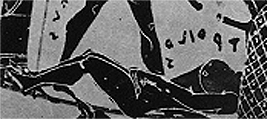
This is what the battle was all about -- rescuing the body of
Troilus, Hector's brother. Note that the Greek's did not hesitate to
write right to left -- the orthodoxy of left to right came later.
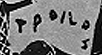
Many inscriptions are written with alternating lines going L->R
and R->L (boustrophedon or like the turning of the cattle in
plowing fields). Thus the dead hero's name reads  (note
that the Greek letter "r" {rho} is shaped like a p and here is turned
backwards with the rest of the letters).
(note
that the Greek letter "r" {rho} is shaped like a p and here is turned
backwards with the rest of the letters).
 The
story of Troilus' death is not told in the Iliad. Homer only
mentions that he is dead. Later sources told that Achilles
ambushed Troilus and his sister as they left the city to draw water.
Achilles chased Troilus into the
temple of Apollo and killed him there. It is generally consider bad
to fight, let alone kill someone, in a temple or sacred precinct or
at an altar. That violates all sorts of religious taboos. Apollo, in
part as retribution for this desecration of his temple, later had a
hand in Achilles' demise. The
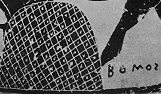
artist depicts the sacred nature of the location of the slaughter by
depicting a bomos or
altar, behind which Troilus has fallen. The concept that religious
buildings confer "sanctuary" exists also in Christian religion.
Victor
Hugo's novel, the Hunchback of Notre Dame, provides a famous
literary example of this. In modern America, there was a large
sanctuary movement for Central American (esp. El Salvadorian)
refugees. The legality of sanctuary is still largely debated in the
U.S.
The
story of Troilus' death is not told in the Iliad. Homer only
mentions that he is dead. Later sources told that Achilles
ambushed Troilus and his sister as they left the city to draw water.
Achilles chased Troilus into the
temple of Apollo and killed him there. It is generally consider bad
to fight, let alone kill someone, in a temple or sacred precinct or
at an altar. That violates all sorts of religious taboos. Apollo, in
part as retribution for this desecration of his temple, later had a
hand in Achilles' demise. The
artist depicts the sacred nature of the location of the slaughter by
depicting a bomos or
altar, behind which Troilus has fallen. The concept that religious
buildings confer "sanctuary" exists also in Christian religion.
Victor
Hugo's novel, the Hunchback of Notre Dame, provides a famous
literary example of this. In modern America, there was a large
sanctuary movement for Central American (esp. El Salvadorian)
refugees. The legality of sanctuary is still largely debated in the
U.S.